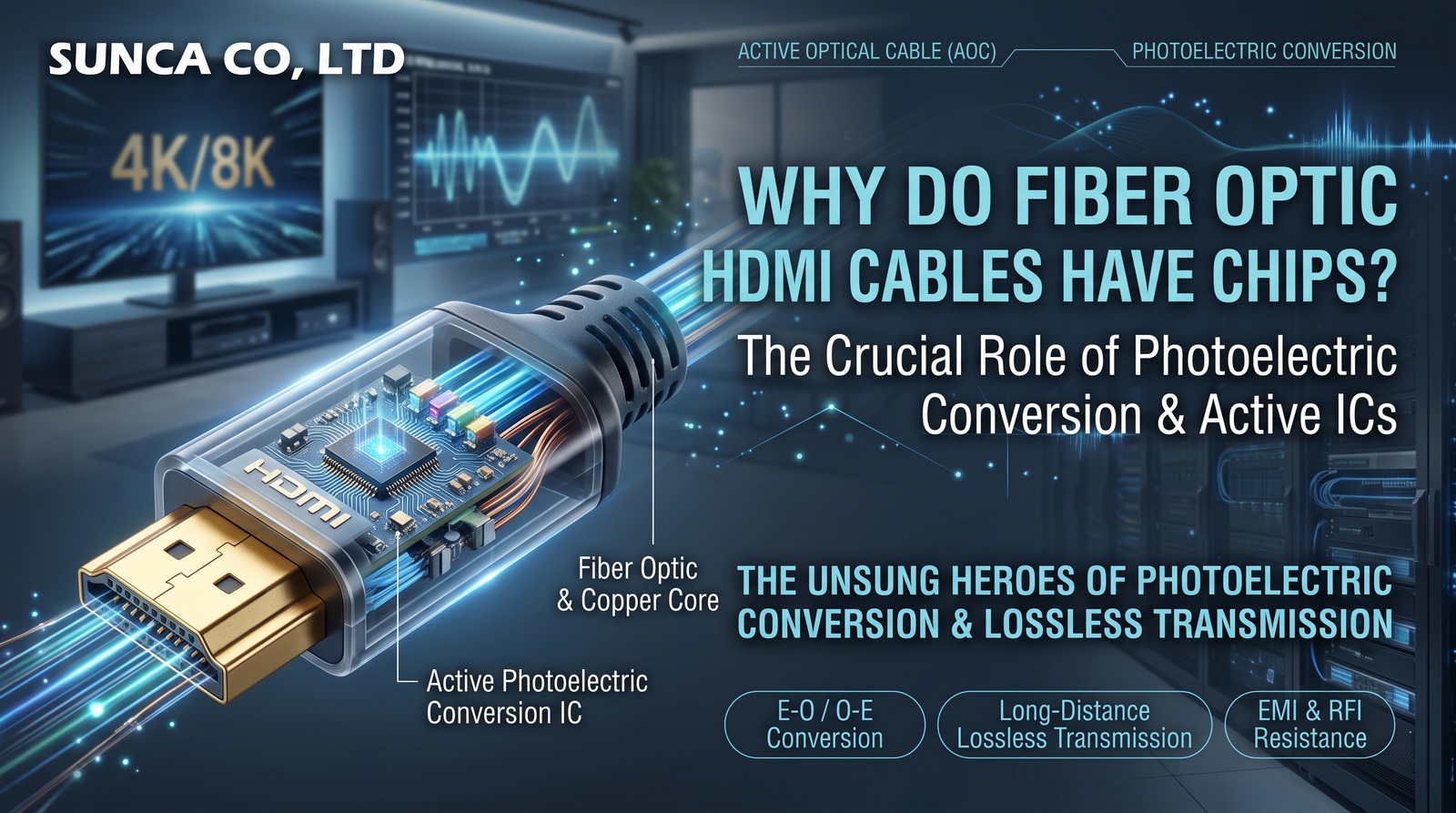
Why Are There “Chips” Inside Active Optical HDMI Cables? The Unsung Heroes of Photoelectric Conversion & Lossless Long-Distance Transmission
What is an Active Optical HDMI Cable (AOC)? How Does It Differ from Traditional HDMI Cables?
In an era of audio-visual media demanding high-definition and long-distance transmission, traditional copper HDMI cables often suffer from signal attenuation, distortion, and electromagnetic interference (EMI) when they exceed 5 meters. To solve these pain points, the Active Optical HDMI Cable (AOC) was created.
AOCs utilize fiber optics as the transmission medium, offering faster speeds and higher bandwidth with virtually zero signal attenuation, easily achieving lossless transmission over dozens or even hundreds of meters.
However, a common question arises: Since it uses optical fiber, why are there “electronic chips (ICs)” inside the connectors?
Why Do Active Optical HDMI Cables Contain Electronic Chips? 4 Core Reasons Explained
The ability of an Active Optical HDMI Cable to combine “the ultra-long distance of optical transmission” with “the signal interfacing of electronic devices” lies entirely in the active chips (photoelectric conversion and control chips) embedded inside the connectors. Their primary functions include:
1. Crucial “Photoelectric Conversion” (The Bridge Between Light and Electricity)
This is the chip’s most critical task.
-
The Transmitter Side (Source): Playback devices (e.g., PCs, PS5) output electrical signals. The chip (containing a laser driver) inside the Source connector immediately modulates and converts these electrical signals into optical signals to be sent through the fiber.
-
The Receiver Side (Display): Display devices (e.g., 4K/8K TVs, projectors) only recognize electrical signals. The chip (containing a photodetector and amplifier) in the Display connector must instantly convert the incoming optical signals back into electrical signals within milliseconds, ensuring data can be correctly decoded and played back.
2. Meeting High Bandwidth & Performance Needs: Supporting 4K 120Hz / 8K 60Hz
Under ultra-high resolution and high refresh rate demands (such as the 48Gbps bandwidth required by HDMI 2.1), signal processing becomes highly complex. The electronic chips on both ends serve to provide signal amplification and equalization, automatically correcting and enhancing high-speed signals to ensure a stable, smooth HDR and high-refresh-rate AV experience.
3. Active Calibration and Superior Anti-Interference (EMI/RFI Protection)
Although optical fibers are naturally immune to electromagnetic interference during the optical transmission stage, the electronic interfaces on both ends are still susceptible to noise. The internal IC chips boast powerful signal conditioning and error-correction capabilities, effectively filtering out interference and stabilizing clock signals, which reduces packet loss and achieves truly interference-free, long-distance transmission.
4. Managing Complex Multi-Functionality & Protocols
An HDMI cable does not only transmit video and audio; it also handles control signals, such as:
-
HDCP (High-bandwidth Digital Content Protection)
-
CEC (Consumer Electronics Control)
-
eARC / ARC (Audio Return Channel)
-
EDID (Extended Display Identification Data)
These non-AV bi-directional control signals mostly still run on electrical signals. The chips must precisely schedule, manage, and dispatch this data to ensure seamless communication between devices without lag.
Why Choose Active Optical HDMI Cables?
| Feature |
Traditional Copper HDMI Cables |
Active Optical HDMI Cables (AOC) |
| Transmission Distance |
Short (stable usually within 5m) |
Extremely long (10m, 30m, to 100m+ without attenuation) |
| Signal Interference |
Prone to electromagnetic interference (EMI) |
Virtually immune to interference |
| Physical Cable Properties |
Thick, heavy, and difficult to route through conduits |
Thin, lightweight, and flexible—ideal for building/industrial routing |
| Active Chips Included |
No |
Yes (direction-specific: “Source” to “Display”) |
Technical Tip: Because photoelectric conversion chips have “directionality,” Active Optical HDMI Cables are marked with “Source” and “Display”. Always check the direction before routing to avoid installing them backward!
Choose SUNCA for Ultimate Audio-Visual & Transmission Quality
The integration of photoelectric conversion and semiconductor chips is what allows Active Optical HDMI Cables to deliver such exceptional performance.SUNCA CO., LTD specializes in the research, development, and manufacture of high-specification, customized cabling. We possess rich experience in Active Optical (AOC) technology.
Whether you require:
-
High-performance fiber optic cables complying with HDMI 2.0 / 2.1 standards.
-
Long-distance customized AOC HDMI solutions for home theaters, conference rooms, outdoor signage, or industrial monitoring.
-
Durable, tug-resistant engineering & industrial-grade optical transmission cables.
SUNCA can provide you with the most advanced technology, strict international certification standards, and custom designs, helping your equipment unleash its full potential to stand out in the digital and audio-visual markets!